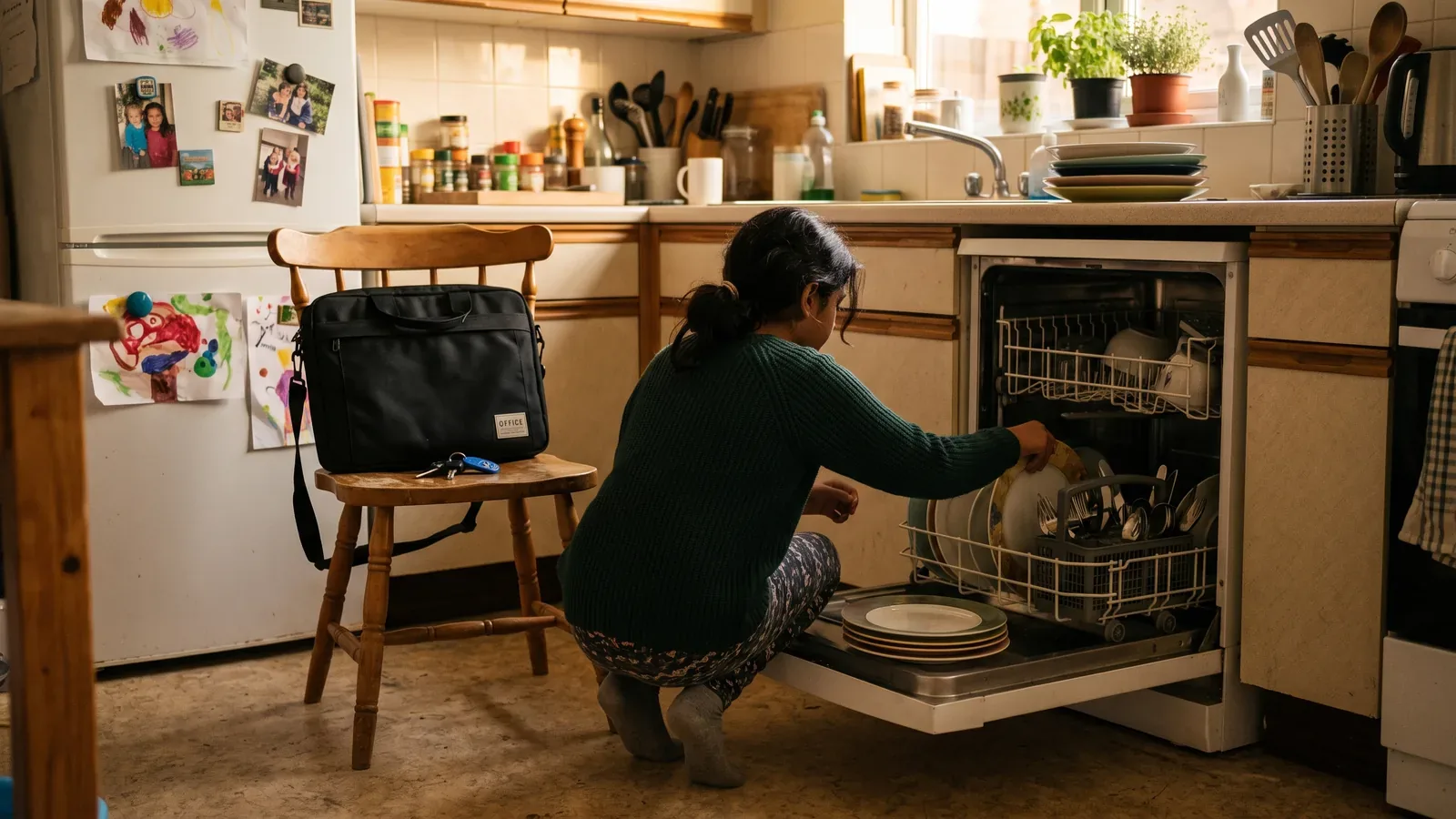
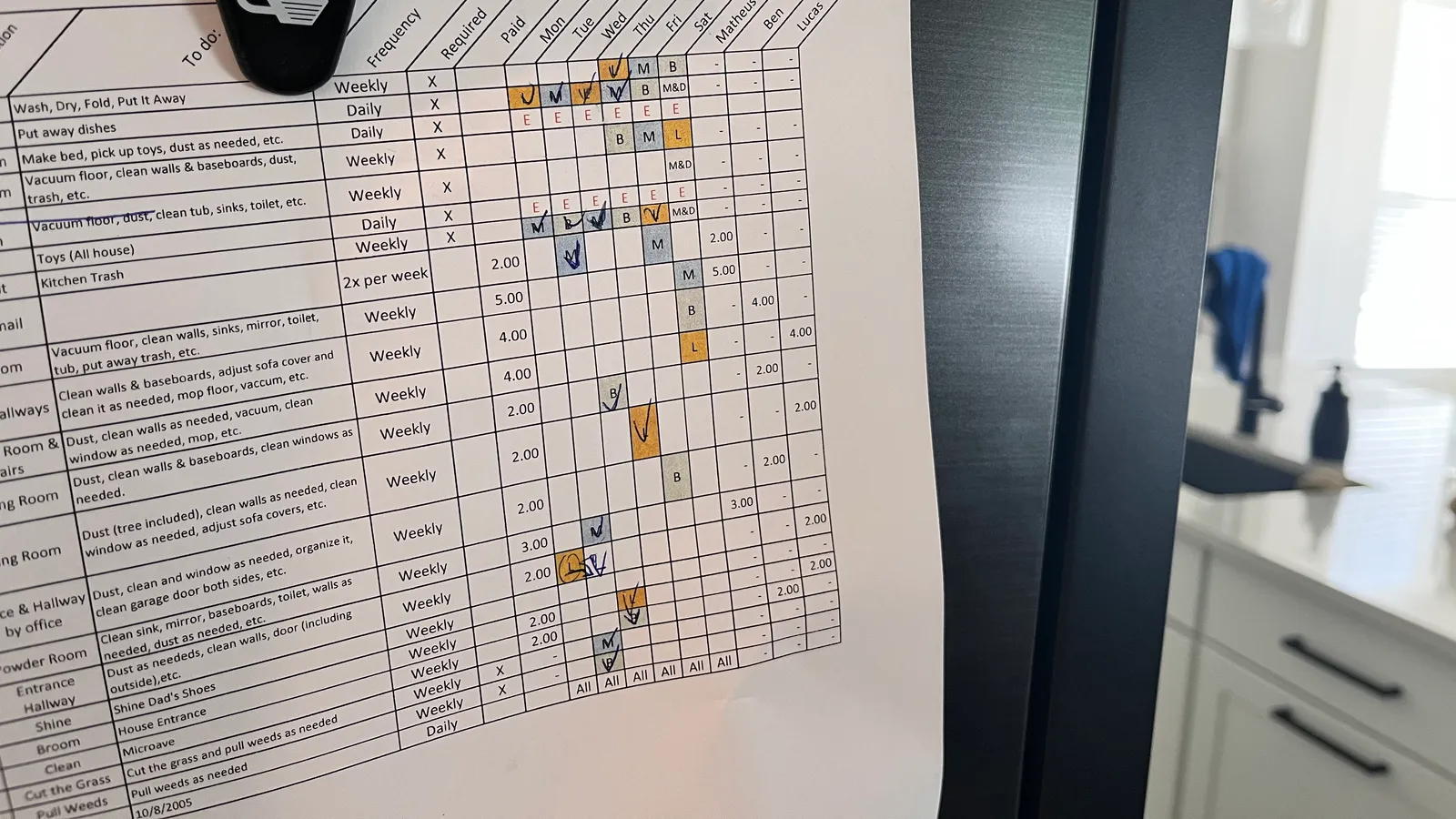
Almost every piece of chore advice quietly assumes an adult is standing there when the chore happens. Build a system you can check after the fact instead: jobs a kid can finish without you, and a consequence that lands while you are still at work.
Twelve chore and allowance apps compared on price, declared languages and features read from their own store screenshots. Verified 17 August 2026 by a dad who built one of them.
Every co-parenting guide says to keep the rules consistent, and almost all of them aim that word at the wrong target. Give each house its own list and its own routine, and share only the three things that actually have to travel between them.
Everyone quotes the same Harvard study. There is no Harvard study of childhood chores. What the real research shows is a modest association nobody has shown to run in the direction everyone assumes — and the thing that actually turns a chore into responsibility is not in any of it.
Every top result says the same thing: do not expect perfection, praise the effort, do not redo it. Then it stops, and you are still holding a half-cleaned bathroom. Grade the job instead — send it back if it matters, let it go if it is cosmetic, and never quietly redo it after they leave the room.
Clean your room is a goal, not a task, which is why kids stall in the doorway. Name three or four piles: clothes, paper, things that live elsewhere in the house, then the floor. Work them in the same order every time. A room that is being maintained is a two-minute lap; ten to fifteen is the full pass.
Summer chores collapse in the first week of school. Hang every chore off a fixed point in the day instead of a time on the clock: before they leave, the first stretch after they walk in, and after dinner. Twenty minutes on a school night, heavy jobs on Saturday.
Every parenting site says to make chores a team effort. In a house with three boys, that is exactly what started the arguing. Why individual rewards and one hard gate beat refereeing, and the one time my kids do cheer each other on.
The research says two to four. My kids have ten, and three of those aren't chores at all: two minutes of meditation, being kind to a brother, and talking to a parent for five minutes. Here's the difference between a chore and a mini-chore, and why ten still takes twenty minutes.
Docking earned money for behavior turns allowance into leverage. Why we keep the wallet out of discipline, the one case where holding pay back is fair, and the behavior lane that ended the negotiating at our house.
Keep a base set of family chores unpaid, and pay only for extra jobs beyond it. Why paying for every chore backfires, where to draw the line, and the two-track split that settled the argument at our house.
Most kids can run a full load on their own around age 10 to 12, but the skill starts years earlier. The by-age laundry ladder, when full independence actually lands, and how to hand it over without becoming the reminder.
Nearly half of parents pay for grades, but the biggest study found paying for the grade itself barely moves anything. Here's what the research says to pay for instead, and how we keep grades and money on separate tracks at home.
By thirteen, "go do your chores" can turn into a nightly standoff. Here's why control backfires with teens, the one shift that ends the fight, and how to set a consequence that teaches instead of escalating.
Skip the sit-down speech. Here's how to talk to kids about money the way that actually sticks: everyday, two-way, and tied to small real trade-offs, from a dad of four.
The scary $37-a-week headline is an all-ages average. Here are the three signs you're actually overpaying, what it quietly costs, and how to dial the number back without a fight.
The scary $37-a-week headline is an all-ages average. Here are the real by-age numbers for 2025, the $1-per-year rule, and how to pick the right amount for your family.
Does your older kid deserve more for the same job? Usually not. What you're actually paying for, the numbers by age, and how to handle the "that's not fair" fight.
What kids can really handle at each age, from toddlers to teens: the by-age list, what "done" should mean, and the part no chart prints, which is getting them to do it.
Most chore systems collapse the moment the parent flinches. The rule that holds, the day my 7-year-old ran out of underwear, and the paid-jobs mistake that nearly broke our whole system.
Why "your responsibility" doesn't land on an 8-year-old, and the membership-not-merit reframe that finally moved chores from a fight to a rhythm in our house.
A dad of 4 tried a taped-to-the-wall chart, Amazon coins, a treasure box, and a paper-circle tracker. All of them died. Here's what finally worked, and why most charts stop working after a few days.
A dad of 4 tried using screen time as a chore reward for a year. Here's when it works, when it backfires, and the rule that finally stopped the daily battle.
Separate family chores from paid jobs, cap the weekly earnings, and split every dollar save, spend, and give. The system a dad of four built across four kids, and the parent match that made saving feel real.
A dad of 4 shares the exact system that stopped the nagging for good — chores vs. jobs, age-appropriate expectations, and why a coin system changed everything.
Chores · 6 min read
Showing 6 of 26 posts
Coming soonHow do you get kids to do chores when they have ADHD?
How do you get kids to do chores without using rewards?
How do you keep chores going over summer break?
Otros idiomasOur app comparison is published natively in five more languages, each with its own storefront pricing and local market data.